Scroll through enough Snapchat profiles and you’ll eventually run into a small planet icon sitting quietly beside someone’s badge, part of a feature users have started calling the snap planets or the Snapchat BFF list. It’s a playful, space themed way of showing exactly where you rank among a friend’s closest connections, but since Snapchat never actually explains the system inside the app, most people are left guessing based on TikTok clips and Reddit threads. Between the planet order, the BSF terminology, and the Snapchat Plus requirement, there’s a lot packed into what looks like a simple little icon. In this guide, we’ll answer exactly what the snap planets mean, how the BSF list connects to this feature, what each planet represents, and how to check your own ranking without any confusion. Read more articles about Snapplanets.
What Do Snap Planets Mean?
At its core, the snap planets are a visual ranking system, and understanding the basic concept clears up most of the confusion people run into when they first spot one.
The Simple Explanation
The snap planets represent your position within a friend’s top eight most interacted with connections, officially called the Friend Solar System, where that friend is treated as the Sun and their eight closest friends orbit around them as individual planets, ranked from Mercury down to Neptune.
- Represents your rank among a friend’s top eight connections
- Officially part of Snapchat’s Friend Solar System feature
- The friend viewing their own list is treated as the Sun
- Their top eight friends orbit as individual named planets
- Mercury marks the closest, most interacted with friend
- Neptune marks the eighth and least active connection
- Based entirely on recent snap and chat activity
- Doesn’t apply to any friend outside that top eight
Is Snap Planets the Official Name?
Snapchat’s own support documentation refers to this feature as the Friend Solar System, meaning snap planets and BSF list planets are simply informal, communitydriven nicknames that spread once the feature went viral, rather than official terminology used within the app itself.
- Officially named the Friend Solar System by Snapchat
- Snap planets is a popular, informal community nickname
- BSF list planets is another common alternate name
- BSF itself simply stands for Best Friends
- None of these nicknames change how the feature functions
- All refer to the exact same underlying system
- Confusion often comes from inconsistent naming online
- Helpful to recognize these terms mean the same thing
What Is the Snapchat BSF List?
Since BSF list is one of the most common ways people refer to this feature, it’s worth explaining exactly how that terminology connects to the planets themselves.
BSF Simply Means Best Friends
The Snapchat BSF list refers to a friend’s existing Best Friends list, the same topeight ranking Snapchat has used for years, which the Friend Solar System feature simply turned into a visual, planetbased display instead of a plain text list.
- BSF is shorthand for Best Friends on Snapchat
- Refers to the same top eight friend ranking as before
- The Solar System feature visualizes this existing list
- Doesn’t introduce a separate or additional ranking system
- Planets are simply a creative display of BSF standings
- Both terms are used interchangeably across online guides
- Understanding this clears up a common naming confusion
- The underlying data has existed on Snapchat for years
View more articles :
- What Does the X Mean on Snapchat?
- How to Tell If Someone Has Snapchat Plus
- What Do the Planets Mean on Snap
- Is Snapchat Shutting Down
- Snapchat Memories Storage
- What Does the Purple Circle Mean on Snapchat
- What Does NRS Mean on Snapchat
- How to Delete Avatar in Snapchat
- What Does HRU Mean in Text
How the BSF List Connects to the Planets
Each position on a friend’s BSF list corresponds directly to one specific planet, meaning your rank on their Best Friends list and your assigned planet are simply two different ways of describing the exact same thing.
- Rank #1 on the BSF list corresponds to Mercury
- Rank #8 on the BSF list corresponds to Neptune
- Every position in between follows the same direct mapping
- Viewing the planet is the same as viewing your BSF rank
- No separate calculation exists between the two systems
- The planet is essentially a decorative label for your rank
- Makes the ranking easier to visualize than a plain list
- Both terms describe identical underlying friendship data
Full Snap Planets Order and Meaning
With the terminology out of the way, here’s exactly what each individual planet represents within the ranking.
Mercury, Venus, Earth, and Mars (Top 4)
The first four positions represent the strongest, most consistently active friendships, starting with Mercury as the single closest connection and gradually softening in intensity through Venus, Earth, and Mars.
- Mercury: your #1 most interacted with friend overall
- Venus: your second closest, still highly active connection
- Earth: your third closest, steady and dependable friendship
- Mars: your fourth closest, energetic and frequent contact
- Mercury and Venus feature the warmest colors and most hearts
- Earth uses natural blue and green tones with red hearts
- Mars stands out with a fiery, dark red design
- All four reflect your most consistently active friendships
Jupiter, Saturn, Uranus, and Neptune (Bottom 4)
The remaining four positions represent friendships that are still active enough to make your top eight, but noticeably quieter than the top four, ending with Neptune as the most distant recognized connection.
- Jupiter: your fifth closest, shown as a large orange planet
- Saturn: your sixth closest, displayed with a golden ring
- Uranus: your seventh closest, shown in a cooler green tone
- Neptune: your eighth and quietest recognized connection
- Colors and hearts grow sparser moving through this group
- Still represents a real, currently active friendship overall
- Being someone’s Neptune still means top eight status
- Reflects reduced, but not nonexistent, recent interaction
Do You Need Snapchat Plus to See Your BSF Planets?
Since this is one of the most common points of confusion, it’s worth confirming exactly what’s required before you can view any planets at all.
Subscription Requirement Confirmed
Yes, according to Snapchat’s official support page, viewing snap planets, whether your own or a friend’s, requires an active Snapchat Plus subscription, and the feature also needs to be manually turned on afterward before any planets become visible.
- Requires an active, currently paid Snapchat Plus subscription
- Free accounts cannot view planets under any circumstance
- Applies to checking both your own and friends’ rankings
- The feature is switched off by default for new subscribers
- Must be manually enabled through Snapchat+ settings
- Available equally on both iPhone and Android devices
- One of several exclusive perks bundled with the subscription
- Confirmed directly through Snapchat’s own help documentation
What Happens Without a Subscription
Without an active Snapchat Plus subscription, tapping a friend’s badge won’t reveal any planet animation at all, regardless of how close your actual friendship or interaction history might be.
- No planet animation appears without an active subscription
- Applies regardless of how close the friendship actually is
- The Best Friends or Friends badge may still appear normally
- Only the planet reveal itself is locked behind Plus
- Subscribing at any time immediately unlocks the feature
- Doesn’t retroactively reveal past rankings before subscribing
- A common reason people report nothing happening when tapping
- Worth confirming your subscription status before troubleshooting further
How to Check Your Snap Planet on a Friend’s BSF List
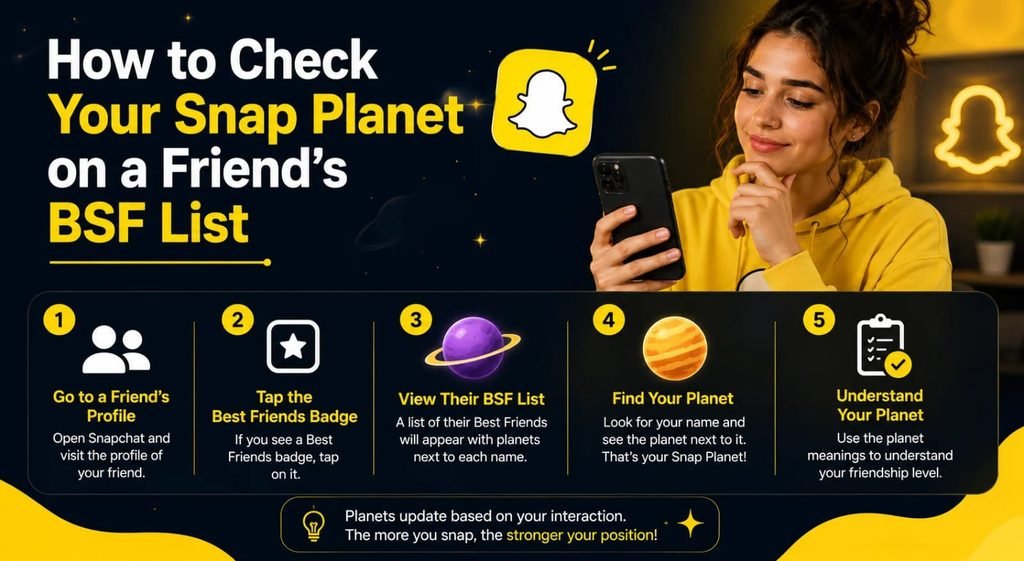
Once you’re subscribed and the feature is enabled, checking your ranking only takes a few seconds.
StepbyStep Instructions
Checking your planet involves opening a specific friend’s profile and interacting with the badge shown there, revealing a short animation that displays exactly where you currently rank.
- Open Snapchat and navigate to your Chats list
- Tap on the friend whose ranking you’d like to check
- Tap their Bitmoji to open their full profile page
- Locate the Best Friends or Friends badge on their profile
- Tap and hold directly on that specific badge
- A brief solar system animation will play automatically
- The animation reveals your current planet position
- Repeat this process for any other friend you’re curious about
Gold Badge vs Regular Badge
Before tapping, you’ll notice one of two badge styles, and knowing the difference helps you understand what kind of ranking relationship you’re about to see revealed.
- A goldringed badge means the top eight ranking is mutual
- You’re in their top eight, and they’re also in yours
- A regular badge without gold means it’s one directional only
- You may rank in their top eight while they don’t rank in yours
- Both badge types still reveal your specific planet when tapped
- The gold badge is considered a stronger friendship signal
- Regular badges are more common than mutual gold ones
- Neither badge type is inherently better, just different signals
Frequently Asked Questions About Snap Planets
Does the BSF List Update in Real Time?
No, the BSF list and its corresponding planets do not update instantly with every snap; instead, Snapchat recalculates rankings periodically in the background, meaning there’s typically a short, normal delay before recent activity is reflected.
- Rankings do not shift instantly with each individual snap
- Recalculation happens periodically, often daily or weekly
- More active users may notice updates more frequently
- A short delay between activity and results is expected
- No manual refresh button exists within the app currently
- Reflects an ongoing pattern rather than one recent action
- Sudden bursts of activity may take time to fully register
- Patience is generally required to see a ranking shift
Can Your Snap Planet Be the Same as a Friend’s?
No, your position in a friend’s solar system and their position in yours are calculated completely independently, meaning you could rank as their Mercury while they rank as only your Saturn, with neither side able to see the other’s specific placement.
- Each person’s solar system is calculated entirely separately
- Your ranking of them has no bearing on their ranking of you
- One person’s Mercury can be the other’s Neptune, or anything else
- Neither friend can see the other’s specific planet assignment
- Only the badge type, gold or plain, is visible to both sides
- Confirmed directly through Snapchat’s own official guidance
- A frequent point of confusion for new Plus subscribers
- Reinforces how personal and one directional the system is
Does Snap Score Affect BSF Planet Rankings?
No, your overall Snap Score and your specific planet ranking with any individual friend are tracked as two completely separate systems, meaning a high total Snap Score doesn’t automatically translate into a closer planet position with any one person.
- Snap Score reflects total activity across the entire app
- Planet rankings are calculated per individual friendship
- A high Snap Score doesn’t guarantee a closer planet position
- The two systems are tracked using completely separate data
- Ranking depends specifically on activity with that one friend
- A common misconception among newer Snapchat Plus users
- Worth remembering these measure genuinely different things
- Neither metric is publicly tied to the other by Snapchat’s design
What Affects Your Position on the BSF List?

Since a friend’s top eight can shift, it helps to understand exactly what kind of behavior actually moves you closer to Mercury or further toward Neptune.
Activity That Improves Your Ranking
Snapchat hasn’t published an exact public formula, but based on its own guidance, consistent, reciprocal snapping and chatting with a specific friend is what gradually moves you closer to the center of their solar system.
- Frequent snaps sent and received with that specific friend
- Regular chat messages exchanged back and forth
- Active streaks maintained with that individual friend
- Twoway, reciprocal interaction rather than onesided snapping
- Recent activity weighted more heavily than older interactions
- Consistency across several days tends to matter more than one burst
- No way to manually request or force a higher ranking
- Genuine, ongoing interaction is the only real way to climb
Behavior That Lowers Your Ranking
On the flip side, reduced contact or long gaps in communication with a specific friend will gradually push you toward the outer planets, even if your overall Snapchat activity elsewhere remains high.
- Long gaps in communication with that specific friend
- Ending or losing a previously active streak together
- Reduced snap and chat frequency compared to other friends
- Being consistently outpaced by someone else’s interaction level
- Doesn’t happen instantly after a single quiet day
- Reflects a gradual pattern rather than one missed message
- Being active elsewhere on the app doesn’t prevent this drop
- A natural result of shifting attention toward other friends
Snap Planets vs Older Snapchat Friendship Emojis
Before planets existed, Snapchat relied entirely on friendship emojis like the yellow heart, and it’s worth understanding how the two systems compare.
How the Two Systems Differ
Friendship emojis like the yellow heart, red heart, and baby icon still exist alongside the newer planet system, but they work differently, often reflecting mutual #1 best friend status specifically, rather than a full ranked list of all eight top connections.
- Emojis like the yellow heart still function independently today
- Yellow heart specifically reflects mutual #1 best friend status
- Planets instead show a full ranked list of all top eight
- Emojis are visible to all users, not just Snapchat Plus subscribers
- Planets require an active Plus subscription to view at all
- Both systems can appear simultaneously on the same profile
- Emojis focus on one specific relationship, planets show a full ranking
- Understanding both helps make sense of everything shown on a profile
Why Snapchat Added the Planet System
Snapchat introduced the planet system as a Plus exclusive feature to add a more detailed, visual, and engaging way of displaying friendship rankings beyond what the existing emoji system could offer.
- Adds detail beyond what a single emoji can represent
- Shows a full top eight ranking instead of one relationship
- Designed to encourage more engagement with Snapchat Plus
- Offers a more visual, gamified friendship experience overall
- Doesn’t replace the existing emoji system entirely
- Builds on top of the same underlying interaction data
- Reflects Snapchat’s broader push toward premium features
- Gives Plus subscribers an additional, exclusive way to connect
Conclusion
The snap planets, also known as the Snapchat BSF list planets, are simply a visual, space themed way of displaying a friend’s existing Best Friends ranking, with Mercury representing their closest connection and Neptune representing their eighth. The feature requires an active Snapchat Plus subscription and must be manually enabled before any planets become visible, and each person’s ranking remains entirely private and calculated independently from everyone else’s. Whether you’ve heard it called the Friend Solar System, the snap planets, or the BSF list, all three terms describe the exact same underlying feature. Now that you understand the terminology, the full planet order, and exactly how to check your own ranking, that small planet icon should never feel confusing again.
Pingback: Can You Have Multiple Yellow Hearts on Snapchat
Pingback: How to Turn Off Snapchat Spotlight Notifications